The Microscopic Dance in Your Jar

A sourdough starter isn't just flour and water. It's a thriving microscopic ecosystem. Within this bustling community, two main protagonists share the stage — they have distinct roles, yet they rely entirely on one another.
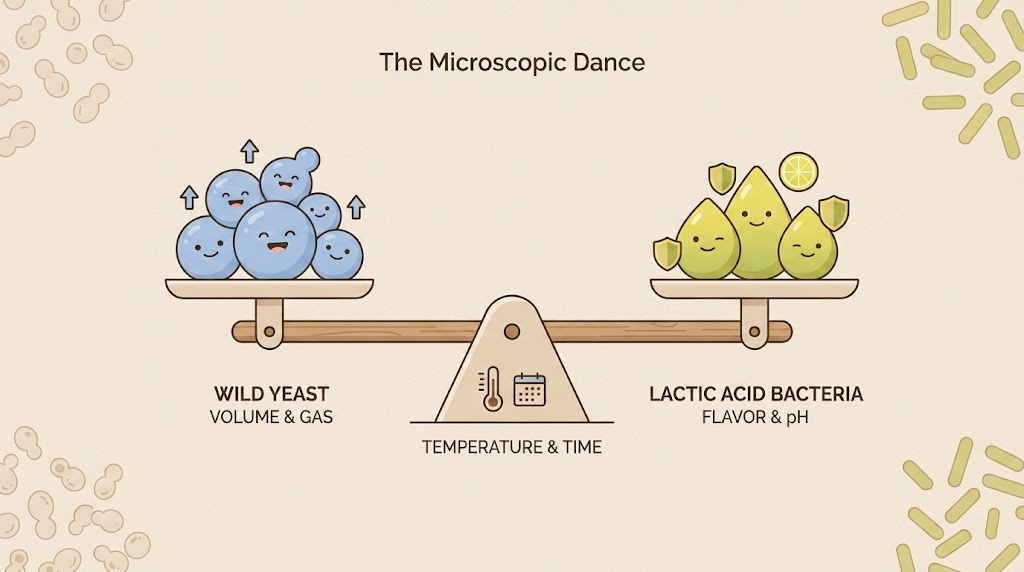
The Two Players
The Architect of Rise and Fluff
These microorganisms feast on the sugars in flour and release CO₂ as a byproduct. They drive your starter's volume expansion — those active bubbles you see are wild yeast at work, giving bread its airy, open crumb.
The Flavor Tuner and Guardian
LAB produces lactic acid (mild, yogurty) and acetic acid (sharp, vinegary), creating sourdough's signature tang. More critically, it lowers the pH — acting as a natural defense system that keeps harmful bacteria out and lets yeast thrive.
Without LAB's acidic protection, the yeast simply wouldn't survive. Without yeast lifting the dough, the bread would be dense and flat. They need each other.
The Golden Rule: A Seesaw of Time and Temperature
Wild yeast and LAB coexist beautifully, but they respond differently to conditions.
🌡️ Warmer (26–28°C / 79–82°F) — Yeast takes the lead
Yeast activity spikes. Your starter rises rapidly with impressive volume, but the flavor stays relatively mild. Good when you need lift; not ideal if you want complexity.
❄️ Cooler temperatures — LAB takes the lead
Acetic-acid-producing LAB strains thrive. Volume expansion slows down, but tangy flavor deepens and becomes much more pronounced. Classic long cold-proof technique.